New feature. You get the idea. Let’s start with an only-in-New-Orleans case that would be a harbinger of the more famous Penn Coal and Euclid decisions: It’s L’Hote v. New Orleans, from 1900.
‘Yes’ on More Humane Farming Practices
The Star-Ledger has an op-ed by Peter Singer and Paul Shapiro in support of a bill (A-3250) that is working its way through the New Jersey General Assembly. The law would ban the use of gestation crates for pigs on New Jersey farms. The companion bill passed the Senate in June, 35-1. According to the authors, similar laws are already on the books throughout Europe, and in nine other American states. Seems like a step in the right direction.
Medical Marijuana: A Dim Green Light
The New Jersey Department of Health is now signing up patients for the state’s newly minted medical marijuana program. The state law that established the framework for the program (N.J.S.A. 24:6I-1, et seq.) was signed by Gov. Jon Corzine in the last days of his outgoing administration, in early 2010. As LT has noted, the program has since been implemented with painful slowness by Gov. Chris Christie’s administration, and has also been subjected to a broad array of land-use obstacles from municipal authorities, as well. (Viz., although six dispensaries have been approved, in theory, only two have yet secured retail space: one in Montclair; and another in Egg Harbor, which is near Atlantic City.)
Update, 8/26: A third location has been secured on U.S. 1 in Woodbridge.
The Lost Public Baths of New York City
Like Caracalla and Diocletian, the mayors of New York City once also built large public baths– and for many of the same reasons that the emperors had. Michael Minn has a nice survey of the major facilities on his New York page. In the late Victorian period, at the end of the 19th century, industrial Gotham was as much a concentration of unwashed humanity as parts of ancient Rome had been, and many of the city’s residential units were just as lacking in indoor plumbing as those of the ancient world. Something had to be done. New York City’s public baths were less elaborate than those of the Romans: Their interiors were not destined to become lasting architectural marvels; nor were they divided into caldaria, tepidaria, and frigidaria; nor built to impress the city’s rich denizens. Nonetheless, public baths were a significant investment in the city’s urban infrastructure, and evidence of these facilities remains.
In the summers, when the need was highest, the pubic baths of New York City were complemented by public swimming pools and beaches. (Minn describes this at his page, above.) But by the early 20th century, the building code required inclusion of bathrooms in new units, and, over time, the city’s older buildings caught up. Subways and cars also allowed people to commute with minimal exertion and perspiration. Accordingly, the baths closed and the swimming facilities became almost purely recreational. Given today’s worries about carbon and street congestion, I wonder if there might be a new role for some range of public bathing facilities that would allow more people to walk or ride bicycles over longer urban distances— and still arrive presentably.
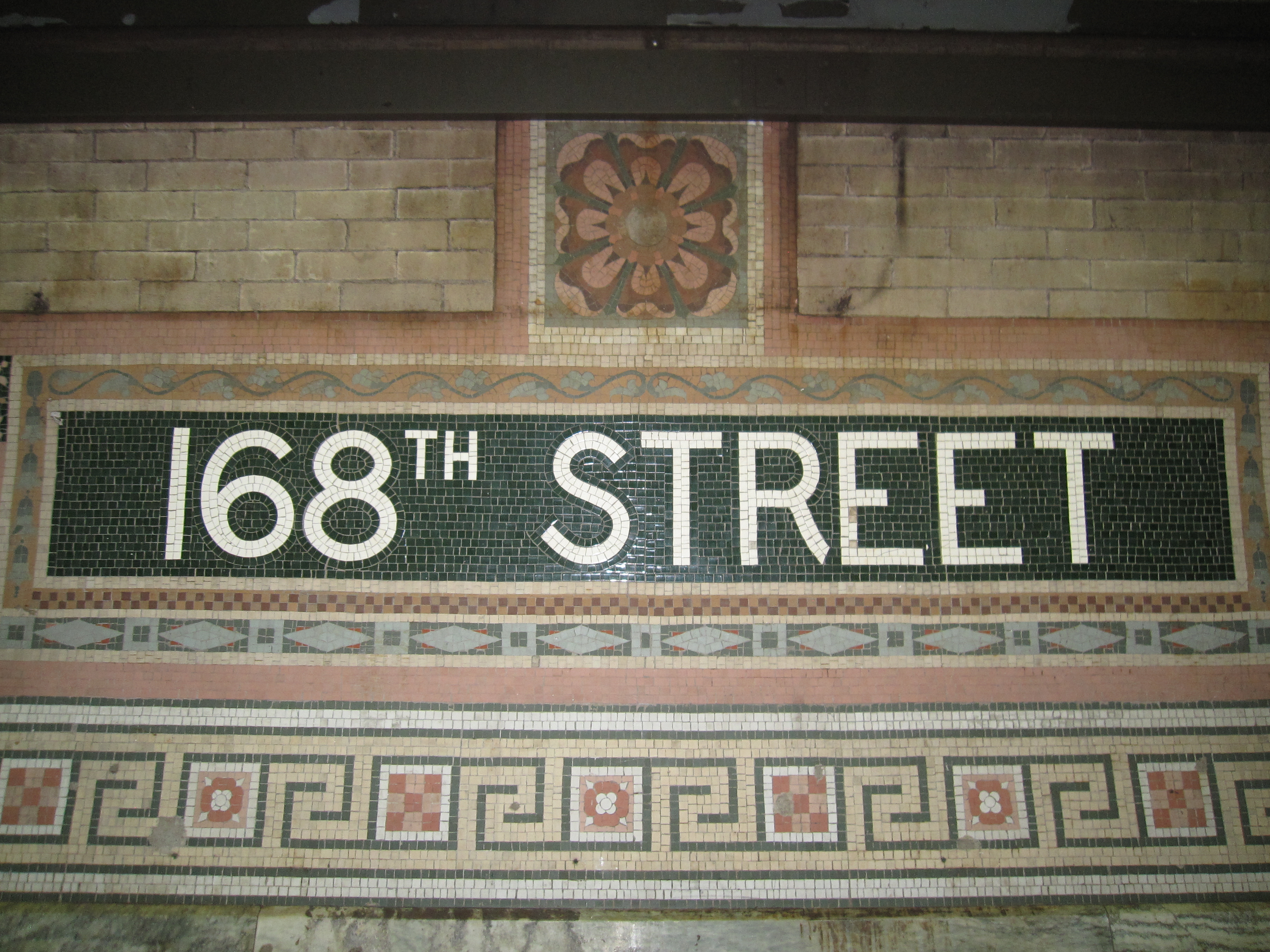
It’s interesting to see how many echoes of the Classical world coursed through the city-building patterns of America in the late Victorian period. Another oddball bath-related example from New York City is the architecture of the 168th Street IRT subway station (now more than a century old), and its uncanny resemblance– in tile-work, passageways, and barrel-vaulted ceilings— to the internal chambers of ancient Roman baths. Other stations of the same era also borrowed Roman bath elements, though usually more subtly. Presumably, the Beaux-Arts reverence of Classical design had a lot to do with these kinds of echoes: Graeco-Roman elements turn up often in the urban relics of a century ago. Modernists found the echoes of the ancient past too rigid, and in some ways they were. But they also provided a valuable framework and common vocabulary for city-building, and their use invested a long period of our urban architecture with symbolism of the longer cultural traditions to which its builders adhered.
France Outdoes America
An interesting story from the Economist: national fertility trends are shifting.
Urban Farming to Reduce Violent Crime?
To the extent I’ve paid attention, I’ve mostly been a skeptic about urban farming. I recoil from thoughts of chickens on Charlestown rooftops or parsnips from vacant lots in Philadelphia. Call me a traditionalist, but, in my mind, there’s just a historical, practical, and aesthetic separation of commercially-productive agriculture and urbanism that deserves to be respected. I mean, who are all of these Williamsburg hipsters to tell the Mesopotamians, and every civilization since them, that they’ve been wrong?
Now comes Mother Jones, to tell us that there actually is value in urban farms— and it’s not that they encourage healthy-eating, or provide another carbon sink, or allow us to stick it to the Man, who would sell us boring, mass-produced tomatoes at the A & P. In a surprisingly compelling piece, Alex Kotlowitz and Emily Schiffer document the social impact of urban farms in Chicago, and how they’ve helped to weave together a new sense of participatory community in a place that has had the mentality of a war zone for years.
In our lifetimes, the depravity of the Drug War, in combination with a host of other bad ideas, has put a very fine point on what can go wrong with city life. In the 19th century, heavy industry did the same. But this story about urban farms causes me to wonder whether the Olmsteds and Howards of the 19th century actually missed a broader point: That is, it may not have been the presence of mere nature that was missing from the massive Victorian cities, so much as the connection to the abiding cultural patterns that are reinforced by proximity to productive land.
The impatience, narcissism, and myopia that so often characterize urban life also feed the violence at its extreme fringes– both on the streets, and in the boardrooms. These tendencies are also, interestingly, tempered by a hands-on relationship with the timeless but predictable ways of nature. With the industrial age, cities became large enough to sever their ties to the land– and with it, their social ties to the patterns of agriculture. So maybe urban farming is onto something: Maybe, if its culture ever reaches a critical mass, it could improve the spirit of our massive cities in ways that parks and suburbs tried, but never could.
I’m still a skeptic, but I’m more interested now than before.
A Map of Early U.S. Politics

Following up on an earlier LT discussion about how maps can be used to describe complex, non-geographic topics: An interesting blog, Mapping the Nation has reproduced a very map-like timeline of American political history from 1776 through Reconstruction. The chart not only illustrates the political parties and presidents during the period, but also the chief justices of the Supreme Court, the leaders of Congress, and a general legislative history of the federal government.
The page on which it appears is maintained by Susan Schulten, who teaches at the University of Denver. In addition to this image, her blog includes a nice collection of rare documents relating to the westward expansion of the United States, and also to the geography and politics of American slavery.
The Radiant City
I found this video tour of Le Corbusier’s real-world Radiant City— the Unité d’Habitation, in Marseille– while looking around on Vimeo. It reminds me of just how ambitious this madman was– and how there’s still something very dispiriting about what actually came of so many 20th-century grand visions. Urban, and otherwise.
Spotlight: Brick Church, East Orange
Here are some pics from the Brick Church neighborhood, which is situated between the Morris & Essex Line and Springdale Avenue, where Upsala College was once located. The section has a rich stock of large Queen Anne Victorians and early 20th century courtyard-style apartments. There are a lot of potential haunted houses in this neighborhood: Far too many structures have been neglected since the 1970s, when the aftermath of the Newark riots took a heavy toll on much of Essex County. For a while, East Orange had an astronomical crime rate, but it’s calmed down a little bit. And the physical beauty of the neighborhood remains: Its buildings are mostly arranged along wide streets, with parkways, deep setbacks, and hundred-year-old trees. As in other parts of Essex, gas lamps still remain on certain blocks. And, of course, the lack of telephone poles and suspended wires.
Here’s a map of the area’s street plan during its early 20th century heyday, around 1912:

The Blight of Power Lines
David Frum had a piece on CNN.com last week in which he advocated an infrastructure program that would follow Germany’s example and bury America’s power lines. I thought of this as I was driving through East Orange, New Jersey recently, and was reminded that that city’s early developers had done just that– and that its aesthetics continue to benefit from their decision. For all of its trouble with poverty and disinvestment since the 1967 Newark riots, East Orange retains an airy and park-like appearance in many of its neighborhoods: There is a complete absence of the black, plastic cables and splintering wooden poles that ordinarily crisscross the American streetscape; and the street lamps are true lamps, rather than arms mounted to telephone poles. In his article, Frum describes practical reasons for burying the wires: fewer outages, fewer maintenance calls, and a ready-made jobs program for construction workers as the Lesser Depression drags on. Standing outside in New Brunswick one evening during graduate school, a classmate from Europe once made a more succinct case: “The cables,” he said, gesturing toward the twilight sky. “It looks like a third-world country.”
