After Burnham: A Classical Plan for Chicago

Chicago 2109 aerial view.

Image: Philip Bess/Notre Dame School of Architecture.

Philip Bess, a professor at the University of Notre Dame’s excellent School of Architecture, is directing a fascinating project called After Burnham: The Notre Dame Plan of Chicago 2109. Building on principles of classical architecture, the plan envisions the future growth of Chicago over the next century in a more holistic pattern, drawing on the traditions and philosophy of Western urbanism in past eras, and using them to shape a modern city. Bess writes:

Modernity brings with it certain genuine human goods, and the successes of modernity can be measured in part by dramatic increases in human mobility, life span, and per capita income wherever modern institutions have established themselves. But these successes come at a price. Powerful accounts abound of the human suffering entailed in the transformation of traditional societies into modern societies; and the modern view of nature as raw material for human purposes has resulted in both the potential and the reality of environmental catastrophes at unprecedented scale (often with harshest impact upon the poor) and has created wholly modern eco-discontents. Last but not least, serious questions about the cultural sustainability of modernity arise in light of the individualist / therapeutic / consumerist character-type that modern societies seem to mass-produce.

A long western intellectual tradition dating from Aristotle views cities, character virtue, and human flourishing as intimately and reciprocally related. If true —and we think it is— this should give thoughtful people pause. Ours is a time of exploding urbanization in the modernizing societies of Asia, Africa and South America, and the aftermath of nearly seventy years of American suburbanization. Both of these phenomena represent distinctively modern forms of human settlement, but neither is typically evaluated holistically with respect to the relationship of urban formal order to environmentally and culturally sustainable human wellbeing.

See After Burnham for yourself. It’s a beautiful and fascinating proposal.
Raymond Unwin’s Town Planning

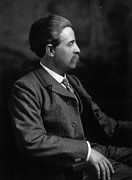
Sir Raymond Unwin

Did I mention that I recently published a long-form review of Raymond Unwin’s Town Planning in Practice at TAC‘s New Urbs?

The Unwin article is the first of a series of pieces that I’ve been writing about classic books of planning (which also includes my more recent piece at TAC about Allan Jacobs’ Great Streets). The idea behind these essays is that there is a canon of writings about the art of traditional, Western European urban planning. It begins, one might suppose, with Aristotle’s description of Hippodamus in his Politics; and continues down through the most timeless pieces of the last century. The landscape of these books is not always apparent; and over the last century, much the oral tradition of building that once sustained these practices dissipated in the face of heavy, technical regulation and the cultural trends of modernity. In light of the renewed interest in planning as an art — and as part of a larger cultural tradition — I think these writings deserve to be read, again, by a wider audience.

If you have any thoughts, please feel free to add comments below the article. There’s no need to register before commenting, and your e-mail address will remain private.

Distilling the Elements of Great Traditional Urbanism

Ruins of the Baths of Caracalla, Rome, at twilight. Viale delle Terme di Caracalla follows the right-of-way of the ancient Via Appia, beyond the grass, at the far left.

My latest article at New Urbs looks at Allan Jacobs’ 1993 planning classic, Great Streets, and argues that the author’s focus on the necessary elements of placemaking, including the aesthetic details of urban planning, marked a turning point in the history of American urbanism. The entire piece can be found here.


Limited Equity: Stable Communities, Affordable Housing

The Amalgamated Dwellings in New York City. Photo: Theo Mackey Pollack.

I have a new article published at TAC’s New Urbs blog, about the history and legal structure of New York City’s limited-equity housing cooperatives, which continue to provide surprisingly affordable, high-quality housing units in one of the most expensive real estate markets in the United States. The piece tells the story about how limited-equity co-ops got started; their philosophical roots; their early successes; why the model declined in popularity; and how an approach that recovers its best qualities might be be compatible with various subsets of the polarized political landscape of contemporary America.

I think there’s little question that the shortage of affordable housing in the regions with the best economies is a major driving force in the structural inequality that characterizes our current moment; and that the biggest beneficiaries of this status quo are rent seekers, rather than actors who contribute anything dynamic or innovative to the economy. Taking the role of speculation out of the equation can do a lot to keep prices in line with what residents can actually afford. For the reasons described in my article, I think this is an important idea that deserves to be recovered and applied in today’s metropolitan real estate economies.

Spotlight: Cities Service Building Update

Cities Service Building
Click on the above photo to see my full album.

My favorite of the city’s Art Deco skyscrapers, this soaring Pine Street tower was built as the headquarters of the Cities Service Company, predecessor of Citgo. The Cities Service logo — a pyramid within a cloverleaf, usually black or green in trade dress — can be found pervasively worked into the concrete and metal exterior details, and the interior details, as well. Designed by architects at Clinton & Russell and Holton & George, the 952-foot tower opened in 1932.

Last year, I posted a batch of pictures that I had taken of the exterior details at ground level; and of the tower within the skyline of Wall Street. It is a striking tower, sleek and tapered at the top. But given the dense cluster of tall buildings that now characterize the neighborhood, it is a challenge to find a clear shot of more than its very top. Fortunately, an outside detail (above) provides a scale model of the complete tower in clean, white concrete — like the building itself.

A residential conversion was recently completed, which includes a beautiful top-to-bottom restoration of the landmark skyscraper. I doubt the building could have looked much sharper in 1932, when it opened amid the Great Depression, having been on the drawing board before the fortunes of Wall Street turned dark. The redeveloper, Rose Associates, has really done an incredible job.

Here, I include a number of new pictures of the grand lobby, the basement, and various stairwells and corridors.

Hope you enjoy. I love this building, and think you will, too.

Spotlight: Rockaway Blues and Coney Island Rain

Rockaway Blues & Coney Island Rain

Click on the above photo to see my full album.

Just some pictures from a couple of trips to New York City beaches this summer. Honey and I made it to Rockaway Beach on an absolutely beautiful day, in early August. The ocean was about as blue as you could imagine, and the beach has been completely remade with white sand and a new boardwalk, replacing the one that was destroyed during Hurricane Sandy. The little things in the photos that look like pebbles are actually tiny clams, coming in by the thousands that day with each wave, then burrowing their way into the sand when the water went out. It was really something to see.

Untitled

Untitled

About a week later, I wound up on a work-related field trip to the coastal parts of Brooklyn, to observe the progress that my program has made in rebuilding private homes in Gerritsen Beach, Sheepshead Bay, and Coney Island. We were supposed to have a happy hour afterwards on the Coney Island Boardwalk, but it was cancelled because of the intermittent (but occasionally heavy) rain. The neighborhood was eerie and abandoned, with wet streets and empty sidewalks. I thought it was photogenic. It’s interesting to me how many of the individual artifacts of the Coney Island my grandparents would have visited are still there — Nathan’s, Luna Park, the Cyclone; and even more interesting, from a planner’s perspective, that this famous seaside spot has never been redeveloped.

Untitled

Untitled

At the end, I included just a few pictures of the work that our program is getting done in the Sandy-affected parts of Brooklyn. It has been a long process getting to a point where physical progress can been seen in these places. Everyone who has been involved in since 2013 should be proud of what he or she has done, especially the homeowners and tenants who have stuck with it for the long haul.

Untitled


Spotlight: The 1913 Woolworth Building

Woolworth Building
Click on the above photo to see my full album!

My office is just across Park Place from the landmark Woolworth Building. Once the world’s tallest skyscraper, the whimsically Gothic tower still dominates the western edge of New York’s town green. Back in the fall, I took a guided tour of the lobby — which is otherwise off limits — which turned out to be a pretty incredible experience. Here are some pictures.

Would definitely recommend to anyone with an interest in the building itself, early skyscrapers, tesellation and mosaics, the transition from classical to modern architecture, or just the history of American business. The colors are incredible. Likewise, the masonry and marble. Photos in my album begin in the main lobby, then move to the back of the main floor, down into the basement (where a lost entrance to the subway can be found, sealed off), and finally up to the balconies, where you can almost touch the tiled ceilings.

Spotlight: 2013 Mount Laurel Exhibit at Rutgers

mtlaurel
Click on the above photo to see the full album.

Here are some pictures I took of a special exhibit at the Rutgers Law Library in 2013, focused on the Mount Laurel doctrine, its history, and its legacy. I just discovered them while I was going through old photos, and thought they might be of interest to some readers. Incidentally, I was in John Payne’s Con Law class during his last semester of teaching at Rutgers. His untimely death was jarring for those of us who were in his class. Interesting fact: he and his wife lived in a Frank Lloyd Wright house, in Glen Ridge.

Spotlight: South Walkway, Manhattan Bridge


Click on the above photo to see the full album.

Was up on the walkway of the Manhattan Bridge. The view is really incredible, especially of the rooftops of Chinatown, and the lower stretch of the East River. The walkway sways a little bit in the wind, and — there are subway tracks right beside it — it really shakes when a subway goes by. It’s much less touristy than the Brooklyn Bridge, and still reminds me a little bit of how the city was in the 80s and early 90s: lots of graffiti, neglected infrastructure, homeless people. I saw three street people getting high, and another lying flat on the walkway.

Spotlight: George Inness in Montclair

George Inness

Click on the above photo to see my full album.

Just some pictures from a recent visit to the Montclair Art Museum, which has a nice collection of George Inness paintings and personal effects. Inness was one of the best artists of 19th century America, specifically, the Northeast. A native of the Hudson Valley, he was sometimes associated with the Hudson River School, but he maintained a distinct approach that defies classification. His palette reminds me a little bit of Van Gogh’s, but his subject matter is much more realist. He spent a bunch of time in Montclair, taking the countryside around Newark as inspiration for a number of his paintings.